For years, Bing has been easy to ignore.
Most Marketing Managers have built their search reporting around Google. Google Search Console, Google Analytics, Google Ads, Google rankings, Google updates. That made sense when search visibility was mostly about ranking positions, impressions and clicks. but AI search has changed the measurement problem.
The question is no longer just:
“Where do we rank?”
It is also:
“Are we being cited in AI answers?”
That is a very different question.
Because in AI search, your brand might appear without the user ever clicking a traditional search result. Your content might be used as a source inside an answer. Your competitors might be cited instead of you. Or your website might be completely invisible, even if you have strong rankings in traditional search.
That is why Bing matters again.
Not because Bing has overtaken Google. Bing matters because Bing Webmaster Tools now gives Marketing Managers one of the clearest free ways to see whether their website is being cited in AI generated answers.
For anyone trying to understand GEO, AEO or AI search visibility, that makes Bing worth looking at again. We covered more about measureability in our most recent Newsletter – Search Sparks – Weekly GEO & AI Search
How do you see citations in AI search?
You can see some AI citations by using the AI Performance report in Bing Webmaster Tools.
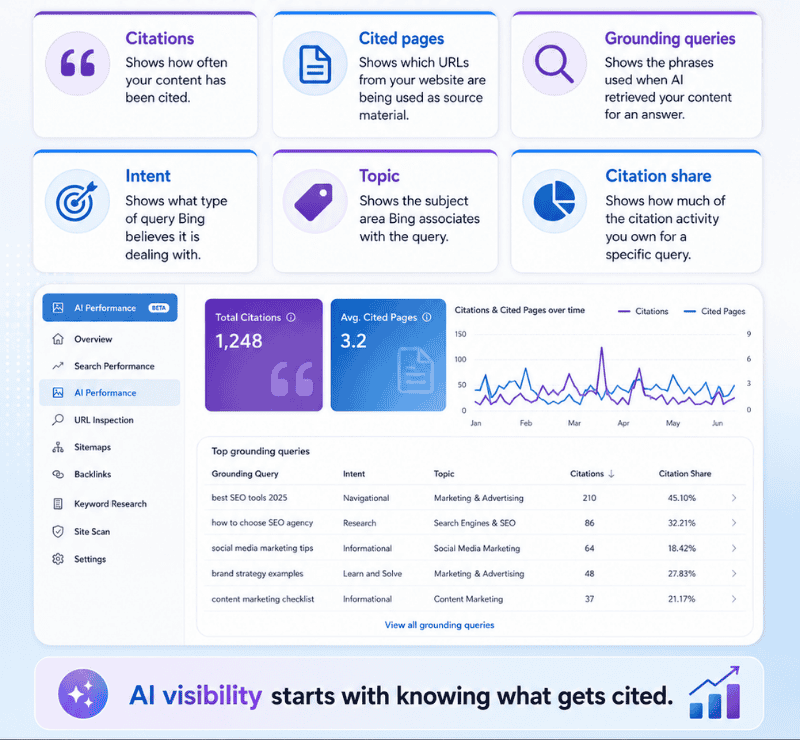
This report shows when your pages are cited across Microsoft Copilot, AI summaries in Bing and selected partner experiences. It can show cited pages, citation counts, grounding queries, intent labels, topic labels and citation share.
That means you can start to answer practical questions such as:
- Which pages are being used as sources in AI answers?
- Which queries are connected to those pages?
- Which topics does Bing associate with our website?
- Are our most cited pages actually useful commercially?
- Where should we optimise next?
It is important to be clear here.
Bing Webmaster Tools does not show every citation across every AI search platform. It will not give you a complete picture of ChatGPT, Perplexity, Gemini, Google AI Overviews and every AI answer engine.
But it does give you a genuine starting point and for many Marketing Managers, that is what has been missing.
What is an AI citation?
An AI citation is when an AI search experience uses a page, source or website as part of an answer.
- Sometimes this appears as a clickable link.
- Sometimes it appears as a source card.
- Sometimes your brand is mentioned in the answer.
- Sometimes the user may see your content referenced without it looking like a traditional search result.
This matters because AI search is changing how people discover information.
In traditional SEO, a user searches, sees a list of links, chooses a result and clicks through. In AI search, the user may ask a full question and receive a complete answer, with sources used to support that answer. That means visibility is moving from ranking alone to citation, retrieval and inclusion.
For Marketing Managers, this creates a new reporting challenge.
You need to know not only whether people can find your website, but whether AI systems consider your content useful enough to cite.
Why Bing Webmaster Tools is useful for AI visibility
Bing Webmaster Tools has historically been viewed as the smaller cousin of Google Search Console.
Useful, but not always urgent.
That is changing because of the AI Performance report.
Instead of only reporting on traditional search performance, Bing now gives site owners data that helps them understand how their content is used across AI search experiences connected to Microsoft’s ecosystem.
The most useful parts of the report are:
So what useful data do you actually pull from Bing WebMaster Tools?
The most interesting part of the report is the grounding query data.
A grounding query is not quite the same as a keyword.
A keyword tells you what a person searched.
A grounding query gives you a clue about what an AI system used when finding information to support an answer.
That difference matters.
In the Brand Ambition export, the top grounding queries included:
- “brand ambition”
- “what’s a benefit of using broad match keywords?”
- “broad match keywords”
- “choose SEO agency for AEO visibility”
- “broad match google ads”
- “how to choose SEO agency for AEO visibility”
- “choosing SEO agency for AEO visibility”
- “best seo tools 2025”
This is extremely useful. It shows the topics and questions Bing’s AI systems already associate with the Brand Ambition website.
Some are navigational.
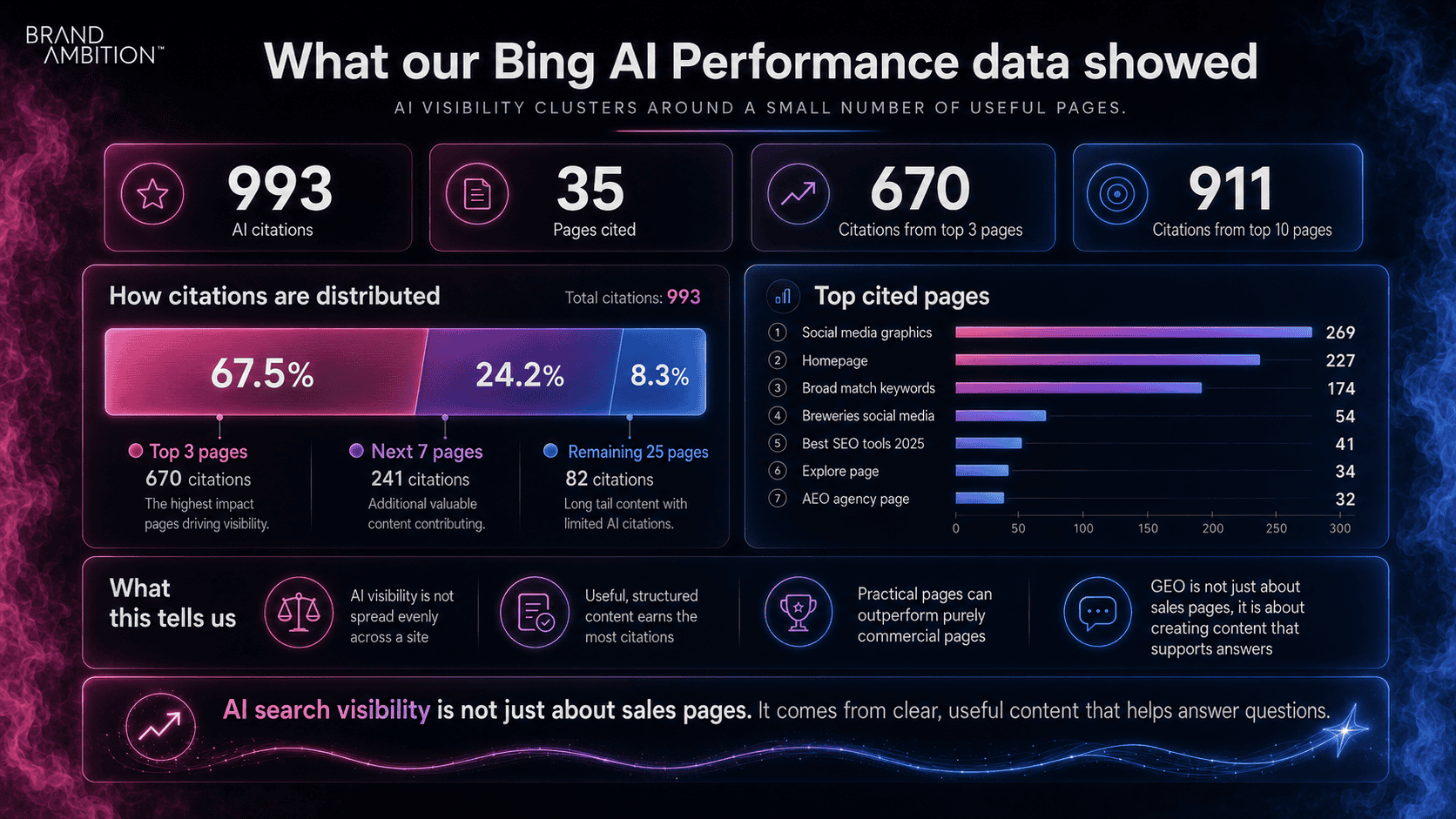
For example, “brand ambition” generated 181 citations. That tells us Bing understands the brand entity and is connecting users directly to us.
Some are informational.
For example, “what’s a benefit of using broad match keywords?” generated 45 citations. That tells us our broad match content is being used to answer a practical paid media question.
Some are commercially valuable.
For example, the AEO queries around choosing an SEO agency for AEO visibility suggest that Bing is already associating Brand Ambition with a service area we actively want to grow.
That is where the opportunity sits. The data does not just show what happened. It shows where to act next.
What Bing shows vs what it does not show
Bing can show which of your pages are being cited within Microsoft’s AI search ecosystem, which grounding queries are linked to those citations, what intent Bing assigns to those queries, what topics they sit within and how much citation share your site receives for a specific grounding query.
What it cannot show you
It does not show every ChatGPT citation. It does not show every Google AI Overview citation. It does not expose competitor domains through Citation Share. It does not tell you traffic share. It does not turn AI visibility into a single ranking score.
This is important because Microsoft specifically states that Citation Share is observational, not a ranking system, traffic share metric or quality score.
How to read your Bing AI Performance report
Start with Cited Pages. This shows which URLs AI systems are already using as source material. These pages should be your first optimisation priority because they already have traction.
Then review Grounding Queries. These show the phrases AI systems used when retrieving your content. Treat these as AI retrieval prompts, not just keywords.
Next, check Intent. If a cited query is informational, the page should answer clearly. If it is commercial, the page should support comparison and decision making. If it is navigational, your brand and entity signals need to be clear.
Then look at Topics. These show which subject areas Bing associates with your website. Use them to identify content clusters, not isolated articles.
Finally, review Citation Share and Compare over time. These help you understand whether visibility is strengthening, weakening or shifting after content updates.
What to do after exporting your Bing AI Performance data
- Sort cited pages by total citations.
- Identify the top 10 pages driving AI visibility.
- Match each page to its grounding queries.
- Add short answer blocks for the highest value queries.
- Improve internal links from cited informational pages to relevant commercial pages.
- Add FAQs that directly answer the grounding queries.
- Check whether multiple pages are being cited for the same query and fix any duplicate intent.
- Use Topics to plan supporting content clusters.
- Use Citation Share to identify queries where you are visible but not dominant.
- Recheck monthly using Compare to see whether visibility changes after optimisation.
What our data changed
Before looking at Bing AI Performance, we might have prioritised the most commercial pages first.
The data changed that.
It showed that our AI visibility was being driven by useful, practical content. The social media graphics article, the broad match keywords article and the brewery social media article were all being cited because they helped answer specific questions.
That gives us a different optimisation order.
Instead of only improving service pages, we should first improve the pages already being retrieved by AI systems, then connect those pages more clearly to commercial journeys.
That is the practical GEO lesson.
You are not only optimising the page you want to sell from. You are optimising the page AI already trusts.
That is a strong point and very Brand Ambition.
how do you see AI citations?
You can see AI citations in Bing Webmaster Tools by opening the AI Performance report. This shows which pages from your website are being cited in AI generated answers across Microsoft Copilot, Bing AI summaries and selected partner experiences.
The most useful data points are citations, cited pages, grounding queries, intent, topic, citation share and comparison over time.
- For wider AI visibility across ChatGPT, Perplexity, Gemini and Google AI Overviews, Bing Webmaster Tools should be used alongside dedicated AI visibility tools.
No. Bing Webmaster Tools does not provide a complete ChatGPT citation report. It shows AI citation data from Microsoft Copilot, Bing AI summaries and selected partner experiences.
A grounding query is the phrase used when an AI system retrieves content to support an answer. It helps show how AI connects a question or topic to your page.
Citation Share shows the percentage of citations attributed to your site for a specific grounding query. Microsoft describes it as an observational metric, not a ranking system or traffic share metric.
Improve them first. Add clearer answers, better headings, FAQs, internal links, source support and relevant commercial CTAs.