I can’t help but smile when I hear people claim that artificial intelligence is the greatest upheaval the creative industries have ever seen. To them, it feels new, it feels fast, it feels frightening. And perhaps it is all three. But in my forty-odd years in advertising and design,
I can say with some authority that AI isn’t the most dramatic change I’ve lived through. That honour belongs to the humble computer, which, when it appeared on our desks in the late 1980s and early 90s, transformed our working practices more profoundly than ChatGPT or MidJourney ever could.
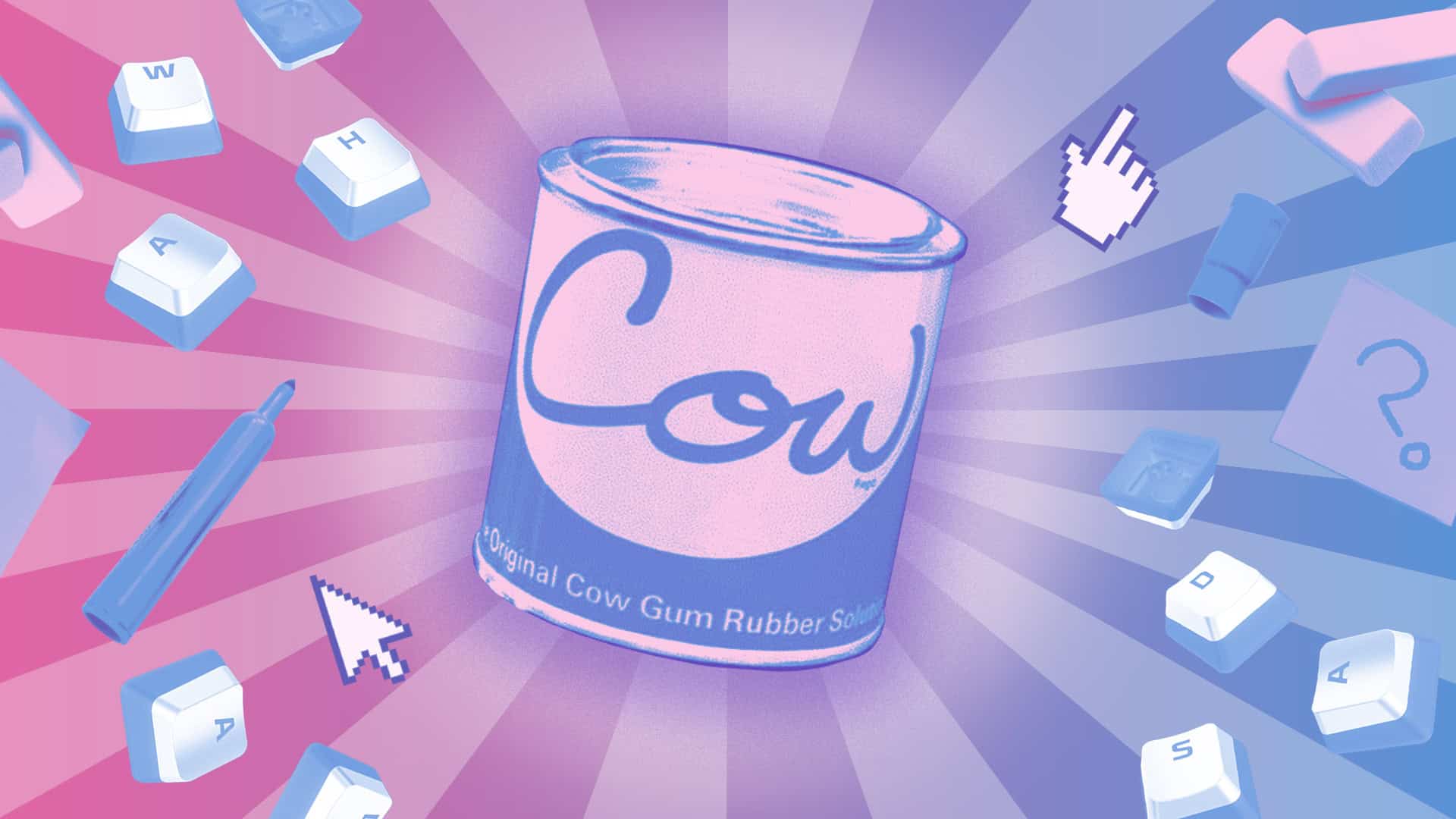
I didn’t start with a keyboard or a screen. My first tools of the trade were Pantone markers, scalpels, T-squares, Rotring pens, and a pot of Cow Gum (an amazing rubbery glue that could stick down bromides but also strip the lining from your lungs). At art college, I was schooled in illustration, litho printing and the mysteries of kerning. In typography classes we learnt about upper and lower case because we literally put the lead characters into the upper and lower cases. These were crafts with centuries of heritage, disciplines passed from master to apprentice. A mistake in letterspacing was corrected with a scalpel, not a backspace key.
My first job out of college was in a newspaper studio. Ads were produced as paste-ups on an artboard with Letraset sheets and hand-rendered headlines. There was no “undo.” If you hadn’t secured every piece of your artwork to the board they would pop off like a confetti explosion if it was bent even slightly. Yet there was also a tactile satisfaction in this process – running your hands across the ruled lines, seeing the ink smudge your cuff, the physicality of design as craft.

After eight years in newspapers, I joined an advertising agency as a “Visualiser” or marker artist. My job was to sketch concepts quickly, often overnight, for client presentations. Colour markers bled onto layout paper as I shaded products and hand-drew headlines, body copy and logos. Speed mattered, but so did artistry. There were people in agencies who could make a biro doodle look like a masterpiece. Those skills, honed over years, were currency in the creative economy.
Then came the computer. First the beige boxes with monochrome screens, then Apple Macs with their revolutionary promise of “desktop publishing.” I remember the first time I saw QuarkXPress in action. Columns of type flowed instantly, kerning could be adjusted with a keyboard command, colour separated at the touch of a button. A process that used to take three people, two hours, and a vat of glue could now be done in minutes by a single operator.

For some, it was terrifying. Whole departments – typesetters, repro houses and subsequently photographers and illustrators – were suddenly surplus to requirements. Skills that had taken decades to master were rendered obsolete almost overnight. The camaraderie of the studio gave way to solitary designers staring at screens. And for Creative Directors like me, the challenge shifted: we had to learn to judge not just ideas on a board, but polished visuals that could sometimes disguise weak concepts with digital trickery.
The arrival of computers didn’t just streamline our work; it redefined it. Turnaround times collapsed, expectations soared. Clients who used to wait weeks for a campaign now demanded concepts in days if not hours. The idea of a “rough layout” vanished, replaced by finished-looking visuals that blurred the line between presentation and production. It was exhilarating but also exhausting. Creativity sped up, but so did the treadmill.
Compare this with AI today. Yes, it’s startling to see a robot generate a passable headline or a fantasy illustration in seconds. But to me, AI feels evolutionary, not revolutionary. It builds on the infrastructure computers created. Without digital workflows, without the internet, without the datasets generated over thirty years of computerised design, AI would have nothing to develop. When we first sat at those clunky Macs, however, we were leaping from centuries of analogue craft into a wholly new digital paradigm. That was a revolution.
Our entire working environment changed and the difference was palpable. A generation of us moved from ink, paper, and scalpel blades to pixels and vectors. The sound of Letraset sheets crackling gave way to the click of a mouse. The smells of marker solvent and spray mount disappeared, replaced by the silent hum of a hard drive. For me, that cultural and professional shift was infinitely greater than today’s nervous chatter about robots taking our jobs.
Don’t get me wrong – I’m not dismissing AI. It will change the way we work, and perhaps even the way we value creative effort. But its role feels supplementary, a tool to assist, to accelerate, perhaps to spark ideas. The computer, by contrast, replaced the very foundation of our processes. It destroyed old roles and created entirely new ones. Without it, there would be no digital marketing industry at all.
I sometimes tell young designers this story when they fear AI will make them redundant. I remind them that creative people have always adapted. When typesetters disappeared, designers took control of their own typography. When artworkers vanished, Creative Directors learned to direct digital production. Now, with AI, it’s the same principle. Adapt the tool to your vision, don’t let it dictate your creativity.
Looking back, I feel privileged to have spanned both worlds. To have smelt the glue, cut the galleys of type and also clicked “Command+Z” with relief. I carry with me the discipline of traditional craft and the flexibility of digital design. That combination, to me, is more valuable than any algorithm.
So when people say AI is the greatest disruption, I chuckle. The real revolution happened the day we swapped markers for a mouse. Everything since then has been an evolution.
Computers didn’t just change how we worked. They changed who we were.