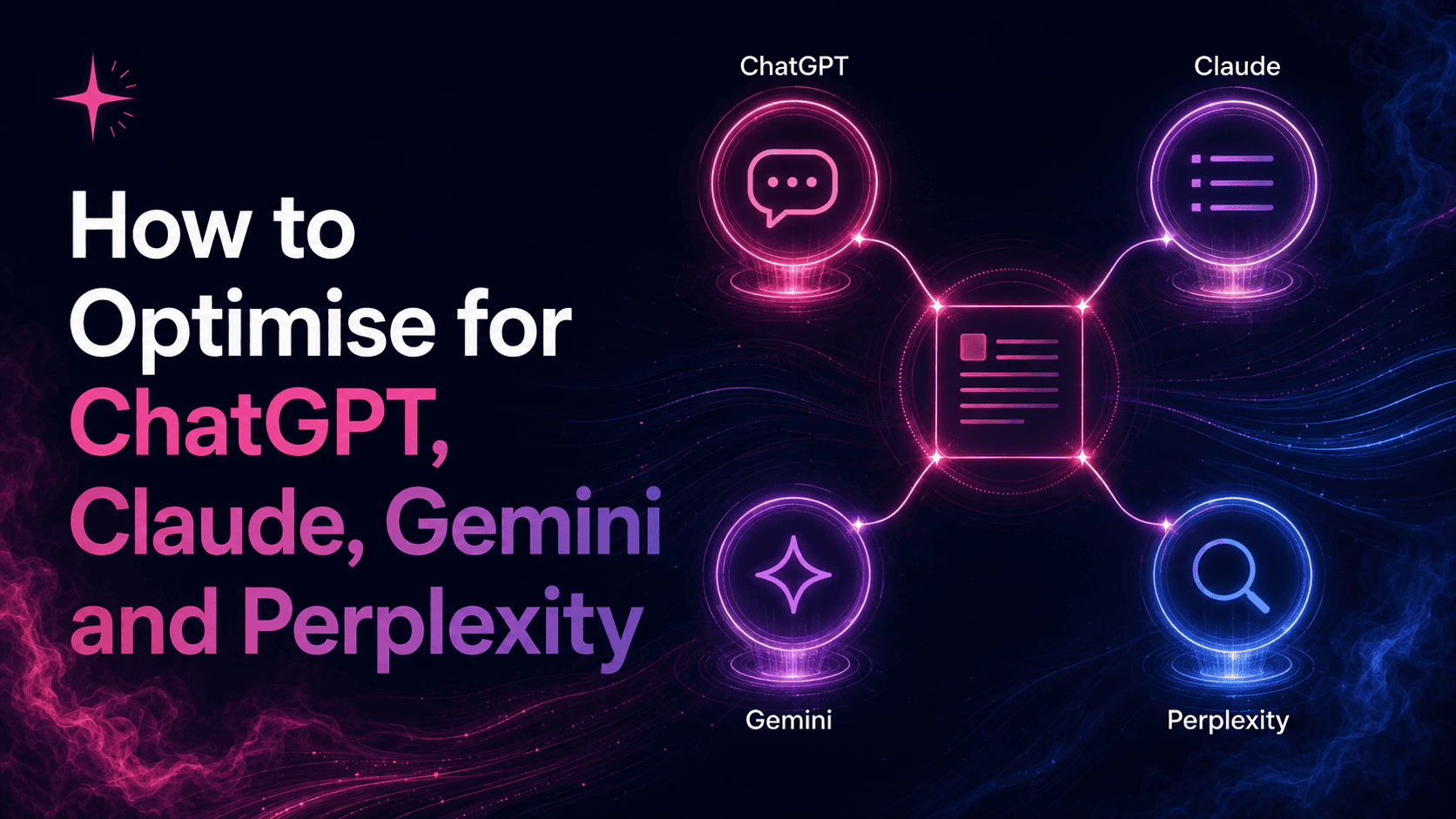
And what AEO actually changes compared to traditional SEO
Over the past 12–18 months, something interesting has started to show up in B2B analytics.
Traffic coming from AI tools and AI-powered search results is often converting significantly better than both organic search and social traffic, even though the volume is still relatively small.
For B2B SMEs, this is not hype. It is a shift in how buyers arrive, not just where they come from.
This article breaks down:
- How AI-driven traffic converts compared to organic search and social for B2B SMEs
- Why the conversion gap exists
- What AEO (Answer Engine Optimisation) requires on top of SEO
- How SMEs should realistically approach this without chasing shiny objects
How B2B SME traffic converts by channel
Across B2B SMEs, especially professional services, SaaS, engineering, and specialist consultancies, the emerging pattern looks like this:
AI-driven traffic
- Lower volume
- Much higher intent
- Often 2x–5x higher conversion rates per visit than organic search
- Users arrive with context, language and problem clarity already formed
AI users are not browsing. They are validating, shortlisting, or preparing to act.
Organic search traffic
- Still the largest and most reliable source of demand
- Strong mid-funnel performance
- Typical B2B SME conversion rates sit around 2–3% depending on offer and friction
Organic search remains foundational. It creates discoverability, authority and scale.
Social traffic
- Lowest direct conversion rates for most B2B SMEs
- Strong awareness and nurture channel
- Rarely intent-led unless paid and tightly targeted
Social influences decisions, but usually converts later via other channels.
Why AI traffic converts better for B2B
This is not because AI is “better traffic”. It is because the filtering has already happened.
When someone clicks through from an AI answer:
- They have already described their problem in detail
- They have already seen multiple viewpoints summarised
- They often arrive pre-sold on the type of solution
- They are validating a supplier, not discovering one
In practical terms, AI compresses the B2B buyer journey.
Instead of:
Awareness → Education → Comparison → Action
You are often getting:
Comparison → Validation → Action
That is why conversion rates look abnormally high.
Where SEO still matters more than ever
There is a dangerous conclusion some people jump to here:
“SEO is dead, just optimise for AI.”
That is wrong.
AI systems still rely heavily on:
- Crawlable content
- Clear structure
- Strong topical authority
- Trusted domains
- Consistent language and definitions
In short, AEO is built on top of SEO, not instead of it.
If your site does not rank, does not explain clearly, and does not demonstrate authority, AI tools have nothing solid to reference.
SEO vs AEO: what actually changes
Traditional SEO and AEO overlap heavily, but the emphasis shifts.
Traditional SEO focuses on:
- Keywords and search intent
- Rankings and click-through
- Page-level optimisation
- Traffic acquisition
AEO adds:
- Answer clarity over keyword density
- Entity-based content, not just pages
- Explicit explanations, definitions and comparisons
- Structured content AI can quote or summarise
- Consistent positioning across the site
Think less “ranking for a phrase” and more “being the clearest source on a topic”.
What B2B SMEs need to add for AEO
Most SMEs do not need a full rebuild. They need refinement.
1. Clear point-of-view content
AI favours confident, unambiguous explanations.
This means:
- Taking a stance
- Explaining trade-offs
- Avoiding vague marketing language
If your content sounds like it could describe any agency or provider, AI will not prioritise it.
2. Explicit answers to real questions
Not hidden in paragraphs. Not implied.
Use:
- Direct questions as headings
- Short, clear answers before elaboration
- Plain language explanations
This mirrors how AI tools structure responses.
3. Consistent expertise signals
AI looks for alignment across:
- Blog content
- Service pages
- Case studies
- Thought leadership
Contradictions weaken authority. Consistency strengthens it.
4. Content that supports decision-making
Comparison content, frameworks, and guidance convert best from AI traffic.
For example:
- “Is X right for SMEs?”
- “When not to use Y”
- “How to choose between A and B”
This matches the stage AI users are already in.
What this means for your marketing strategy
For B2B SMEs, the smartest approach right now is not choosing between SEO and AEO.
It is:
- Using SEO to build visibility, trust and scale
- Using AEO principles to improve clarity, authority and conversion quality
AI traffic will likely remain a smaller slice of overall visits in the near term, but it can punch well above its weight in lead quality.
If your content is built purely to attract clicks, you will miss that opportunity.
The Brand Ambition view
At Brand Ambition, we see AEO as an evolution of good SEO, not a replacement.
The brands winning in AI-led discovery are not gaming systems. They are:
- Clear
- Opinionated
- Useful
- Easy to understand
If your site explains what you do better than your competitors, AI will notice. Buyers will too.
Final thought
AI traffic converts better because it rewards clarity.
SEO gets people to your door.
AEO helps them decide to walk through it.
If you want help aligning your content, SEO strategy and AEO readiness for B2B growth, that is exactly the kind of work we enjoy doing.