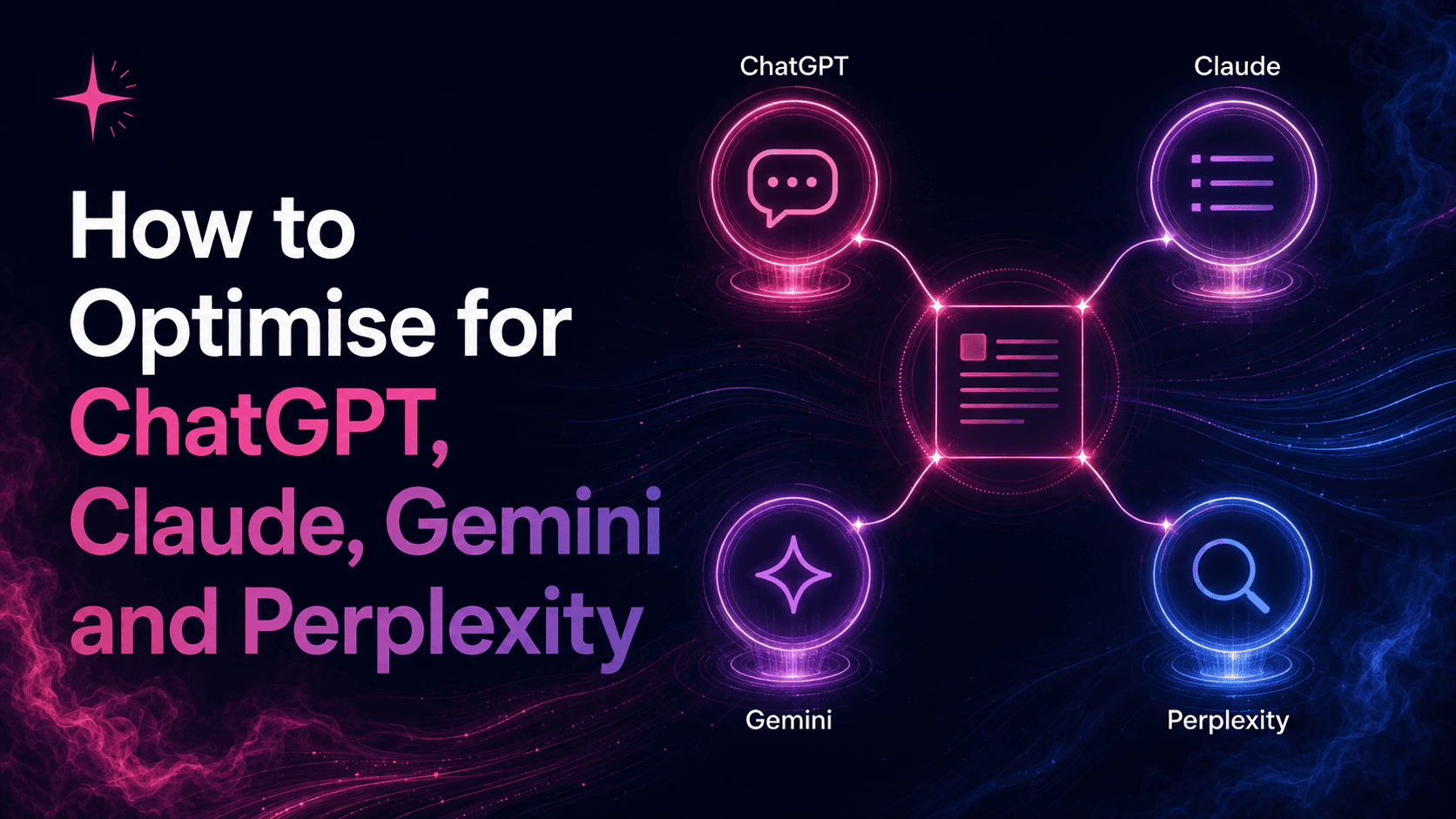
AI search is often discussed as though it is a single channel.
It is not.
A person can ask ChatGPT, Claude, Gemini and Perplexity exactly the same question and receive different sources, different recommendations and, sometimes, a completely different answer.
That does not mean marketers need four entirely separate content strategies. It does mean that “optimising for AI” is too vague to be useful.
The practical approach is to build a strong foundation that makes your business understandable, retrievable and credible across every platform. You can then make targeted adjustments based on the engines your audience is most likely to use.
This article looks at what is genuinely different between ChatGPT, Claude, Gemini and Perplexity, what appears to work across all four, and where the available evidence is still too limited to justify confident claims.

The short answer
To optimise across ChatGPT, Claude, Gemini and Perplexity:
- Make sure each platform can access and retrieve your important content.
- Answer specific audience questions clearly and provide evidence that can be quoted.
- Establish your brand, people, products and expertise consistently across your website and trusted third-party sources.
- Publish information in more than one format, particularly written content and video.
- Earn independent mentions in the publications, communities and industry sources the engines already trust.
- Measure prompts, mentions, citations and recommendations separately for each platform.
The shared foundation matters most. Platform-specific optimisation should refine it, not replace it.
Why the same prompt produces different answers
AI engines do not all search the same index, consult the same sources or assemble answers in the same way.
Even products owned by the same company can behave differently. Google states that AI Overviews and AI Mode may use different models and techniques, so the responses and supporting links can vary. Both may also use “query fan-out”, running several related searches across subtopics and data sources before constructing an answer. Google Search Central
Independent research points in the same direction. Conductor tracked seven AI experiences across seven intent categories between September 2025 and March 2026. It found persistent differences in the source types favoured by ChatGPT, ChatGPT Search, Perplexity, Google AI Overviews, AI Mode and Gemini. Its Claude data covered only two months, so that part should be treated as an early signal rather than a settled rule. Conductor’s seven-month citation analysis
More recent BrightEdge ecommerce research found that ChatGPT, Gemini and Google AI Overviews shared 28 of their top 50 mentioned brands, but only 13 of their top 50 cited domains. In other words, the engines agreed more often about which brands belonged in the answer than about the evidence used to support them. BrightEdge’s 12-week ecommerce analysis
That is the useful distinction. Your overall brand authority can transfer between engines, but the content and sources that earn the visible citation may not.
ChatGPT vs Claude vs Gemini vs Perplexity
| Platform | How current information is retrieved | Emerging source pattern | Practical priority |
|---|---|---|---|
| ChatGPT | Uses live web search when Search is invoked, alongside model knowledge and conversational context | Comparative research found a stronger reference and encyclopaedic pattern, with Reddit appearing more for support queries | Allow the search crawler, create reference-quality answers and strengthen external brand mentions |
| Claude | Uses web search and direct page retrieval, with separate bots for search, user requests and model development | Early evidence suggests a preference for brand-owned, institutional, technical and primary sources | Make primary documentation, expert evidence and compliance information easy to retrieve |
| Gemini | Closely connected to Google Search and Google’s wider ecosystem | Video, particularly YouTube, appears frequently in comparative citation studies | Video, particularly YouTube, appears frequently in comparative citation studies |
| Perplexity | Designed around live retrieval, citations and user-directed page fetching | Comparative studies show a strong preference for YouTube and community or expert discussion in several intents | Remove crawler barriers, publish current source-rich answers and distribute expertise beyond your own website |
These patterns are useful for prioritisation, but they are not permanent ranking factors. Models, retrieval systems and source weightings change frequently. BrightEdge found that citation share changed by 39% week on week in ChatGPT and 41% in Gemini during its 12-week ecommerce study. Brand mentions were more stable than the URLs used as evidence.
The goal is therefore not to reverse-engineer a fixed algorithm. It is to create enough credible, accessible evidence that your brand can be selected across changing systems.

How to optimise for ChatGPT
The first nuance is that ChatGPT and ChatGPT Search are not quite the same optimisation problem.
A response can draw on information learned during model training, the context supplied by the user, connected sources and live web search. A brand may therefore be known by ChatGPT without receiving a visible citation, or cited by ChatGPT Search without being strongly represented in answers generated from model knowledge.
Make your site available to ChatGPT Search
OpenAI uses OAI-SearchBot to surface websites in ChatGPT’s search features. It is separate from GPTBot, which is associated with potential model training. A website can allow search access while blocking training access. OpenAI warns that sites opting out of OAI-SearchBot will not appear in ChatGPT search answers, although they may still appear as navigational links. OpenAI’s crawler documentation
For marketers, that means robots.txt decisions should not be left to a generic “block all AI bots” rule. Search visibility and model training are different choices.
Create reference-quality content
Conductor’s research found ChatGPT Search repeatedly citing Wikipedia for education, recommendation, comparison and purchase intents. That does not mean the answer is to imitate Wikipedia or try to manipulate it. The more useful lesson is that ChatGPT Search appears to value content with the characteristics of a good reference source:
- Clear definitions
- Named entities and unambiguous relationships
- Neutral explanations before sales messaging
- Direct comparisons
- Traceable facts and primary evidence
- Sections that can stand alone when retrieved
A product page that only says a service is “innovative”, “tailored” and “market-leading” gives the engine very little evidence to work with. A page that explains who the service is for, what problem it solves, how delivery works, what it costs and what results have been achieved is far easier to use in an answer.
Strengthen brand knowledge beyond your own site
ChatGPT optimisation is not confined to the page you want cited. Consistent third-party mentions help an AI system connect your brand with a category, service, location and area of expertise.
Digital PR, trade publication coverage, relevant directories, review platforms, podcasts and genuine community participation can all contribute. The objective is not simply to collect links. It is to create independent corroboration of what your business does and why it should be considered.

How to optimise for Claude
Claude deserves a separate strategy because its retrieval controls and early source preferences are materially different.
Anthropic documents three distinct bots:
ClaudeBotfor content that may contribute to model developmentClaude-Userfor pages retrieved in response to a user requestClaude-SearchBotfor improving search result quality
Blocking Claude-User can prevent Claude from retrieving your content for a user’s question. Blocking Claude-SearchBot may reduce your visibility and accuracy in Claude’s search results. Anthropic’s crawler guidance
Again, the commercial lesson is to separate training policy from search visibility rather than blocking every Anthropic bot by default.
Prioritise primary and institutional evidence
Conductor only had two months of Claude data, but the early pattern was striking. Across the rank-one citation slots it monitored, Claude did not favour YouTube, Wikipedia or Reddit. Its citations concentrated on brand-owned, institutional and compliance-grade sources.
This is not enough evidence to claim that Claude always prefers formal content. It is enough to justify testing a different emphasis, particularly for B2B, healthcare, finance, engineering and other evidence-heavy sectors.
Useful content for Claude is likely to include:
- Detailed service and product documentation
- Methodology pages
- Original research with transparent sample information
- Technical specifications
- Policies, standards and compliance statements
- Expert biographies with verifiable experience
- Case studies that state the problem, intervention and measurable result
The common thread is not formality for its own sake. It is first-party information that can be checked and attributed accurately.
Make expertise explicit
Claude cannot infer every relationship a human reader takes for granted. Explain who authored the content, their role, their relevant experience, the organisation they represent and the evidence behind the claim.
This improves the page for every engine, but it is especially relevant when the likely source set favours primary documents and expert material.

How to optimise for Gemini
Gemini sits within Google’s ecosystem, but it should not be treated as identical to AI Overviews or AI Mode.
Google says there are no special technical requirements or secret AI markup needed to appear in its AI Search features. A page must be indexed and eligible to appear in Google Search with a snippet. Google recommends the familiar foundations: crawlability, internal links, strong page experience, important information in text, useful images and video, accurate structured data, and current Business Profile and Merchant Center information. Google’s guidance for AI features
Google also explicitly says there is no special schema or AI text file required. That is an important corrective to some of the more enthusiastic advice surrounding llms.txt.
Treat SEO as the entry point
For Gemini and Google’s AI Search experiences, technical SEO remains the clearest foundation:
- Ensure valuable pages can be crawled and indexed
- Use internal links to establish topic relationships
- Keep canonicalisation, rendering and status codes clean
- Match structured data to visible page content
- Maintain accurate product, location and organisational information
- Cover the follow-up questions created by query fan-out
Query fan-out also changes how content planning should work. A single broad article may not be enough if the engine searches separately for definitions, comparisons, costs, risks, examples and local considerations. A connected topic cluster gives Google more relevant evidence across those subqueries.
Invest in video where it improves the answer
Conductor found Gemini strongly anchored to YouTube across its monitored intents, including support queries. BrightEdge also observed YouTube’s share of AI Overview citations rising from roughly 31% to 65% during an 11-week period, although that result relates to ecommerce and should not be applied blindly to every sector.
The practical conclusion is not “turn every blog into a video”. It is to identify questions where demonstration, explanation or comparison genuinely benefits from video, then publish a useful YouTube version with:
- A precise title based on the audience’s question
- A clear spoken answer early in the video
- Chapters and a useful description
- Accurate captions or a transcript
- Links to the relevant detailed page
- Consistent product, expert and brand naming
For many B2B businesses, this is a significant gap and therefore a realistic opportunity.

How to optimise for Perplexity
Perplexity is the clearest example of an answer engine built around live retrieval and visible sourcing.
It documents two relevant user agents. PerplexityBot indexes information to surface and link websites in search results. Perplexity-User may retrieve a page when a person asks a question. Perplexity recommends allowing its search bot and published IP ranges, and notes that web application firewalls can prevent access even when robots.txt appears correct. Perplexity’s crawler documentation
Remove technical retrieval barriers
Check more than robots.txt. JavaScript rendering, CDN rules, bot protection and WAF challenges can all make a technically public page unavailable to an answer engine.
Important information should be present in accessible HTML, not hidden behind an interaction, login, embedded PDF viewer or script the crawler cannot reliably process.
Publish current, source-rich answers
Perplexity users often expect a researched answer with several visible citations. Content is therefore more useful when it provides specific evidence rather than an unsupported summary.
Good source material includes:
- Recent statistics with dates and links to the original dataset
- Clear comparisons using consistent criteria
- Quotes from named experts
- Tables that make options easy to contrast
- Transparent methodology
- Updates that state what changed and when
Conductor also found Perplexity favouring YouTube for education and recommendation queries throughout its study period. That reinforces the need to treat useful video as part of search distribution, not merely social content.
Build authority in the sources Perplexity consults
Community and expert discussion can influence Perplexity’s evidence set. That does not justify manufacturing Reddit threads or flooding forums with brand mentions. Those tactics are easy to spot, reputationally risky and unlikely to remain effective.
A better approach is to contribute genuinely useful answers where your audience already discusses the subject, encourage credible customers and practitioners to share their experience, and make your expertise available to publishers and creators who cover the category.
What works across all four engines
The platform differences are real, but they should not distract from the larger shared opportunity.
1. Be technically accessible
Review robots.txt, crawler permissions, CDN behaviour, server logs and WAF rules. Treat search crawlers, user-triggered fetchers and training bots as separate policy decisions.
2. Answer the question before expanding
Place the clearest answer near the beginning of the relevant section. Follow it with evidence, examples, limitations and context. This helps both human readers and systems retrieving a passage from the page.
3. Make your entities unambiguous
Use consistent names for the organisation, services, products, experts and locations. Explain how they relate to one another. Support that information with appropriate organisation, person, product, service and article schema where it accurately reflects visible content.
4. Publish evidence others cannot recreate
Original data, named expert insight, case studies, tools, frameworks and first-hand experience give engines a reason to use your source instead of another generic summary.
5. Earn third-party corroboration
Your website explains what you claim. Independent sources help establish whether the claim should be trusted. Digital PR, reviews, industry coverage, relevant listings and expert participation therefore form part of AI search optimisation.
6. Cover the topic in several places and formats
Create a connected evidence footprint across your website, YouTube, social channels, trade media, review sites and relevant communities. Do not copy and paste the same article everywhere. Adapt the information to the role each platform plays.
7. Measure mentions, citations and recommendations separately
A citation is not the same as being named. Being named is not the same as being recommended first. Track all three by platform and prompt theme.
BrightEdge’s research also shows why one-off testing is unreliable. Citation sources can change substantially from week to week while the set of recommended brands remains comparatively stable. Use a consistent prompt set and look for trends over several weeks.
Should SMEs create a separate strategy for every AI engine?
Usually, no.
For most SMEs, the best allocation of effort is roughly:
- 70% shared foundation: technical accessibility, useful content, clear entities, original evidence and third-party authority
- 20% audience-led distribution: the publications, video platforms, communities and review sources used in the buying journey
- 10% engine-specific testing: crawler checks, prompt monitoring and targeted content experiments for the platforms that matter most
The percentages are directional rather than a formula. The important point is to avoid spending most of the budget chasing small platform quirks while the website remains vague, poorly evidenced or inaccessible.
A healthcare consultancy may place more emphasis on Claude’s apparent preference for institutional sources. A consumer product brand may prioritise Gemini, AI Overviews, YouTube and merchant data. A research-led B2B firm may focus first on ChatGPT Search and Perplexity. The right weighting depends on where the audience actually researches and how the purchase is made.
The practical takeaway
There is no single AI result to optimise for.
ChatGPT, Claude, Gemini and Perplexity retrieve and weigh information differently. They may agree that a brand belongs in the conversation while using completely different pages to justify the answer.
The answer is not four disconnected content strategies. It is one credible, accessible and well-distributed body of evidence, strengthened with platform-specific choices where the data supports them.
Start by making your business easy to understand and verify. Make sure the engines can access the content. Publish answers worth quoting. Build evidence on and beyond your website. Then measure each platform separately.
That is where AI search optimisation becomes more useful than simply trying to “rank in ChatGPT”.
SEO provides an important foundation, particularly for Gemini and Google’s AI features, but it is not enough on its own. AI visibility can also depend on platform-specific crawler access, third-party brand mentions, source preferences, video, community discussion and the evidence available across the wider web.
Not usually. Begin with one high-quality source that answers the question clearly and provides original evidence. Adapt and distribute that expertise in the formats and places favoured by the engines and your audience, rather than creating four near-identical articles.
llms.txt improve AI search visibility? There is currently no reliable evidence that an llms.txt file improves rankings or citations across the major consumer AI search platforms. Google explicitly says no new AI text files or special markup are required for its AI Search features. It may still have uses for documentation access in specific systems, but it should not replace crawlability, indexation and strong content.
If AI search visibility is a goal, allow the search and user-retrieval bots needed to access your public content. Decide separately whether to permit bots used for potential model training. Review the latest official documentation for each platform and confirm your CDN or WAF is not blocking legitimate requests.
Prioritise the engines your customers actually use, the prompts closest to a commercial decision and the platforms already influencing your analytics or sales conversations. If that information is unavailable, establish a small cross-platform benchmark before committing significant budget.